Is your home ready for a new electrical panel?
@safeservice
November 24, 2026 · 7 min read
If your home still uses an older fuse box or a panel that maxes out on a warm evening when the air conditioner kicks on, you may be wondering whether it is time for a residential panel replacement. Before any work begins, an electrician will run a residential load calculation. This calculation tells you a lot about your current system and what a new panel needs to handle. Understanding it helps you make an informed decision and avoid overspending on capacity you will never use.
What a residential load calculation actually measures
A load calculation is a methodical way to add up all the electrical demands your house places on its service. The electrician starts with the square footage of the home and counts every light fixture, every standard outlet, and every major appliance you have. The result is expressed in amperage or volt-amperes, and it tells you the minimum size the main breaker and the service entrance conductors need to be.
The calculation is not just a simple sum of every device you own. It takes into account that you do not run everything at full power at the same time. For example, your oven, your clothes dryer, and your central air conditioner all draw a lot of current, but you rarely operate all three simultaneously. The calculation applies a demand factor to these loads so the final number reflects a realistic peak. This number is called the demand load. It is the figure that determines whether your current panel is adequate or whether an electrical service upgrade is required.
What the result tells you about your current panel
Your existing panel has a rating stamped on its main breaker. Common ratings for older homes are 60, 100, or 125 amps. Newer homes and remodeled properties often have 150 or 200 amp services. The load calculation tells you whether your current service rating is still safe for the way you live today.
If the calculated demand load comes close to or exceeds your main breaker rating, the panel is considered overloaded. That does not mean your house is in immediate danger, but it does mean that the breaker could trip during normal peak use. More importantly, an overloaded panel suggests that the service entrance wiring, the meter base, and the panel bus bars are being pushed beyond their design limits. That is a situation that calls for a residential panel replacement.
If the demand load is well below the panel rating, you have headroom. That is a good sign, but it does not automatically mean the panel is in good condition. Age, corrosion, loose connections, and insufficient breaker slots are all reasons to upgrade even when the load calculation looks comfortable.
How the calculation affects the size of a new panel
When an electrician designs a replacement panel, they use the load calculation to choose the appropriate service rating. Oversizing a panel is wasteful because the utility company may charge a higher monthly fee for a larger service, and the larger meter and service entrance conductors cost more to install. Undersizing a panel is dangerous and could require another upgrade in a few years.
The calculation also determines how many breaker spaces you need. The electrician counts every general lighting and receptacle circuit, then adds dedicated circuits for appliances such as the range, the water heater, the dishwasher, the disposal, the washing machine, the dryer, and any heat pumps or air handlers. A modern kitchen alone may need four or five dedicated appliance circuits. The panel must have enough slots for all of these, plus a few spare spaces for future additions.
This is where the load calculation intersects with a decision about an electrical service upgrade. If your current service is 100 amps and the calculation shows a demand load of 95 amps, a new 100-amp panel would work, but it would leave no room for an electric vehicle charger, a hot tub, or a future addition. Many homeowners choose to bump up to 125 or 150 amps at the time of replacement to give themselves breathing room. The load calculation provides the baseline so the electrician can explain the trade-off between cost and future capacity.
What the electrician checks beyond the number
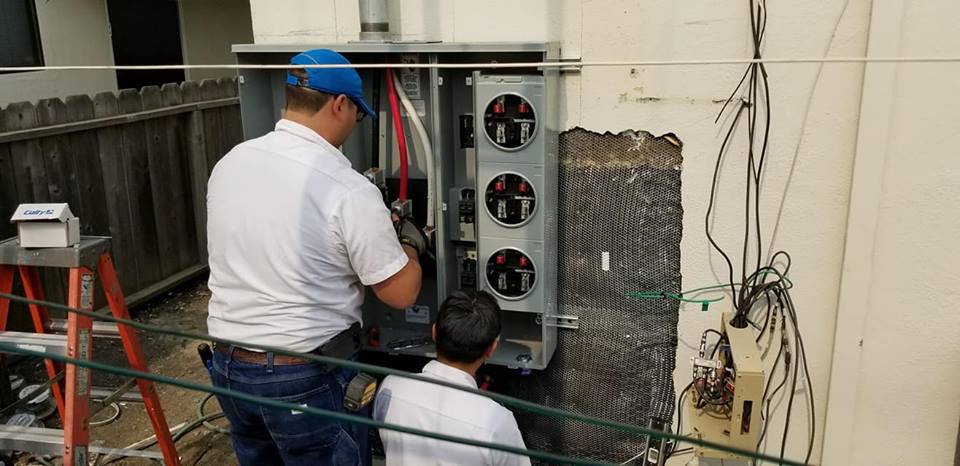
A load calculation is not the only factor in a panel replacement. The electrician will also inspect the condition of the meter base and the service entrance cable. If those are undersized or deteriorated, the utility company may require them to be upgraded before they approve the new panel. The load calculation reveals whether the existing service entrance can handle the new service rating or whether the entire path from the utility transformer to the panel needs to be reworked.
The age of the panel matters too. Older panels often have aluminum bus bars that can become brittle, and they may lack the physical clearance needed for modern arc-fault circuit interrupters (AFCIs) and ground-fault circuit interrupters (GFCIs). These safety devices are now required by code for most circuits in living areas, kitchens, bathrooms, and outdoors. A panel that is too small or too old to accept these breakers is a strong candidate for replacement even if the load calculation says you have headroom.
Signs that a load calculation is overdue
- Your main breaker trips on hot days when the air conditioner and the refrigerator are both running.
- You have added major appliances, a home office, or a workshop since the house was built, and you have not upgraded the panel.
- Your panel has no spare breaker slots, but you need to add a circuit for a new appliance.
- The panel box feels warm to the touch or shows signs of rust or corrosion on the inside.
- Your home still uses a fuse-type panel with screw-in fuses rather than modern circuit breakers.
Any one of these signs warrants a professional evaluation. An electrician will perform a load calculation as part of that evaluation. The result gives you a clear answer about whether a residential panel replacement is necessary and what size the new panel should be.
How a load calculation helps you plan for the future
If you are planning to add solar panels, a battery storage system, or an electric vehicle charger, the load calculation becomes even more important. Adding a large load like a Level 2 EV charger can add 30 to 50 amps of demand. If your current panel is already near its limit, you will not be able to install the charger without a service upgrade. The load calculation tells you in advance whether you have the headroom or whether you need to plan for a panel replacement at the same time as the charger installation.
The same logic applies to a kitchen remodel. A new kitchen often requires several new circuits: one for the refrigerator, one for the microwave, one for the dishwasher, and possibly a separate circuit for the range hood or an induction cooktop. The load calculation accounts for these new loads and shows whether the existing service can handle them. If it cannot, the panel replacement becomes part of the remodel budget, not a surprise expense.
What the process looks like from your side
You do not need to do anything special to prepare for a load calculation. The electrician will walk through your home, note every appliance and its nameplate rating, measure the floor area, and count the number of general-purpose circuits. They will then run the calculation using standard formulas from the National Electrical Code. The whole process takes less than an hour in most homes.
After the calculation, the electrician will show you the demand load compared to your current service rating. If a residential panel replacement is recommended, they will explain the new service rating they propose and why. They should also explain any upgrades needed to the meter base or service entrance. At that point, you have a clear picture of what the work involves and what it will cost.
Why you should not skip this step
Some homeowners assume that a new panel simply replaces the old one at the same size. That assumption can be wrong. Building codes have changed. The way you use electricity has changed. A load calculation exposes whether your home's electrical system matches your actual usage. Without it, you risk installing a panel that is too small to meet modern demands or too large for your needs, paying for capacity you cannot use.
A professional load calculation is a straightforward, low-cost assessment that takes the guesswork out of a residential panel replacement. It gives you confidence that the new panel will be safe, code-compliant, and sized for both your current lifestyle and the changes you are likely to make. If you are considering an upgrade, start with the calculation. It is the first step toward a reliable and safe electrical system for your home.